By Yannis Samatas
I have just driven past Georgioupoli and turned towards Vamos. I am in the Apokoronas area, one of the greenest landscapes in Crete, dotted with pretty traditional villages, between Chania and Rethymnon.
I have often taken these roads and the landscape is engraved on my memory. But the wounded hillside in front of me is not in any of the images I remember.
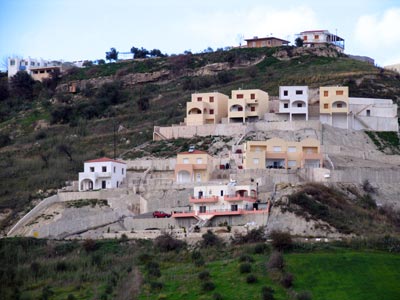
On the mountain opposite, the green carpet covering Crete at this time of year simply doesn’t exist. A huge section of the slope has been devoured by bulldozers. Vomiting black smoke, they have turned the rocks, thyme and sage bushes into flat, cement-covered terraces. Large two-storey houses in pastel shades have already been built on the terraces, while a red car parked between them is visible from a distance.
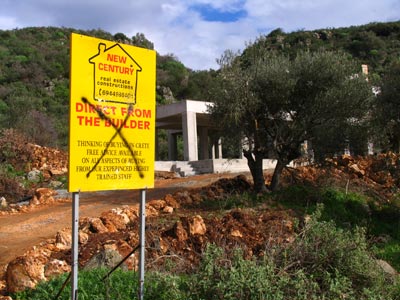
I leave my car and take a few photos, still shaken by this unexpected sight. The bright yellow sign on the right of the road, a few metres further on, answers my questions as to who has taken over this pretty hillside.
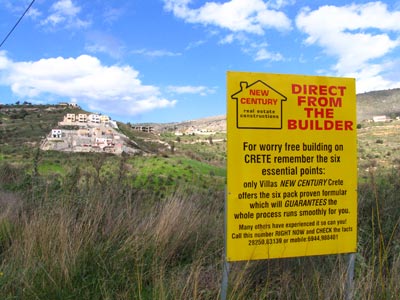
Directly from the builder, the sign proclaims, these homes were constructed to house the Northern Europeans who, deprived of sun and blue sea, seek them in the southernmost corner of Europe, beautiful Crete.
After Spain and Cyprus, it is now Crete’s turn to surrender to the peaceful invasion of well-off foreigners. Over the past few years, people who do not hesitate to spend a few hundred thousand euros in order to enjoy the Mediterranean sunshine for a few months a year, have been buying up land and property at increasing rates. Suddenly, in just five years, FOR SALE signs are sprouting, faster and faster, among the ancient olive trees of Apokoronas and indeed across the whole of Crete. These signs feed the prospering class of estate agents and constructors, professions flowering in Crete in the new millennium. Especially as regards estate agents, the question springs to mind: “Which came first, the chicken or the egg?” The agent sells a house to a Northern European customer, the customer moves to Crete, drinks his fill of sun and sea and then decides to become an estate agent in his turn, selling more houses to friends and acquaintances, in an attempt to redeem the inflated price he paid for a piece of land or a ruined house in some village. An easy job with big profits, they say – but is it true?
I drive on to Kalyves. Once there were three villages a short distance apart: Kalyves, Almyrida and Plaka. Today they are indistinguishable; Plaka and Almyrida especially have merged into one. New houses pop up one after the other, on their own or in small groups, covering the hills by the shore.
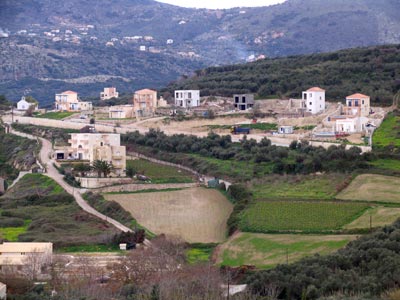
What strikes one is the size of these houses. These aren’t just simple little homes but luxury two- and three-storey buildings, often with a swimming pool. Why do you need a pool when you’re just a few steps from the sea? Hey, when you pay 250,000-1,000,000 euros for a seaside villa, why not put in a swimming pool that will look pretty when it’s lit up at night? Other cultures, other concepts…
Don’t get me wrong, the houses aren’t ugly. Some are even much more beautiful than those built by Cretans for their families. After all, Cretans themselves have shown the greatest lack of respect for the local environment and the beauties of the landscape. What annoys me in this case is the huge change taking place in Apokoronas and the area’s consequent loss of identity.
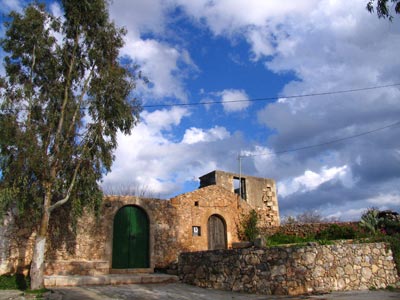
Although close to the large city of Chania, Apokoronas remained until recently an area of outstanding natural beauty, with only mild forms of development. There was some tourist development here and there, mainly in Georgioupoli and Kalyves, and to a lesser extent in Plaka and Almyrida. Apokoronas was one of the first places where mild projects were implemented, such as the agrotourism business in Vamos, where old houses and schools were renovated and transformed into lovely traditional hostels, respecting the traditional local architecture. Similar efforts followed at Machairoi and Provarma.
Unlike these projects, the new building development doesn’t follow these models but imposes western-style houses next to traditional village homes. How can the huge, modern, impressive villa harmonize with the plain and simple, traditional stone-built house?
Apokoronas, in fact, has been taken by surprise by the development of recent years. The same goes for the rest of Crete. The blame lies exclusively with the Greek State for its lack of planning and regulation to preserve the island’s traditional architectural identity. No-one is saying we should ban building on Crete, nor should we make our foreign friends the scapegoats for the problems besetting the island. In any case, the reaction of the local Apokoronas community to new development is largely positive: there is a rise in land values, a boost to the local economy and an influx of life and action in villages at risk of being left deserted by the exodus of young people to the cities. Of course, there are still those who are worried and saddened by the unconditional selling-off of Crete, as shown by the red X someone has painted over an estate agent’s sign.
A short drive around the lovely area of Apokoronas gives rise to many questions and considerations:
Since we already have shining examples of new developments which respect the Cretan environment and local architecture, such as the village of Milia in Kissamos, why don’t we learn from the sensitivity of those daring romantics who resist easy profits and embrace local identity? Why can’t we see that Loutro in Sfakia retains its beauty because the Archaeological Service has enacted stringent regulations to preserve the local traditional style of architecture – white houses with blue wooden doors and windows? Or is a better example supplied by Santorini and the preservation of Cycladic architecture?
Yes, foreigners will always want to come to our country and build homes here, but it must be done in a way that respects the natural beauty and architecture of Crete. Let them come here and receive guidance, help and protection.
– Guidance in their first steps and the process of relocating to a foreign country.
– Help in understanding how things are done in Greece and learning the Greek language.
– Protection from unscrupulous salesmen who will try to exploit their ignorance and good faith and sell them run-down ruins at prices usually reserved for luxury town-centre apartments.
It is disgraceful that all information currently comes from friends, acquaintances and private or commercial websites, while the Greek State is invisible. It is disgraceful that this land with its thousands of years of history has been abandoned defenceless to the new state of affairs, with no planning for the future.
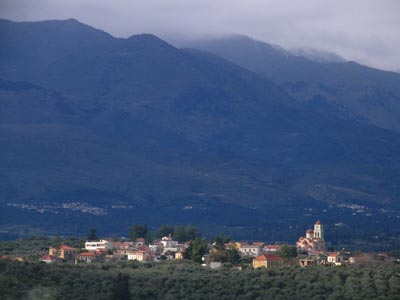
Let those responsible act now, before we see a faceless, characterless, soulless Crete. Let us plan for the future so that we may visit Apokoronas without feeling sorrow and nostalgia for the lost beauty of yesteryear.
In Afrata (Rodopos penninsula) there is a big ugly new home on a large lot owned by a foreigner on the top of a hill. It is so out of character that you have to wonder who is in charge of these matters!
I am sorry you feel that way Yannis. In my case I bought a large plot of land (17.5 strema) with a friend and his family and built 3 houses on it. For a while the site looked ugly with brown scars from the construction vehicles. Now, however, the natural vegetation has returned.
We have 100 olive trees (many over 100 years old) that were neglected for decades, with broken branches and never pruned. Now, with the help of my local Cretan friends, these trees are farmed again,(135kg of oil this year, in the ‘bad’ year of the 2 year cycle). These trees are now looked after properly (the original owner of the olive grove has lived in Canada for the past 40 years, and had no interest in the land).
Stone walls which were crumbling and falling into the road have also been rebuilt. Since 2004, we have spent well over 1 MILLION euros – this is money that has gone from the UK directly into the Cretan economy – not just builders, but architects, lawyers, EOT staff, IKA etc and local craftsmen such as woodworkers, stonemasons, iron makers etc.
The old road between Almyrida and Gavalochori is now tarmac, making it safer and easier for all users, especially the other olive grove owners nearby, who no longer scrape their car engines on what was a very rough dirt track.
There is now electricity in the area, plus OTE poles for future telephone links. Our 3 houses are mainly for tourist rental – again bringing more foreign money into the economy for local tavernas, shops and services for many years to come.
We have no intention of making a fast buck and running away to spend our “profits” elsewhere. Any money we do make is re-invested in the infrastructure – and when this is complete, we will likely invest our money in other local businesses, not necessarily construction.
This area of Crete has certainly changed over the past 5 years, but it will never get to the same state as Spain. In my area, outside the Town Plan, development is restricted to only 200 metre sq of build in any 4000 metre sq of land. (Where I have 3 houses, in Spain there would be a complex of 100 apartments!) I am confident that my development of this neglected olive grove is a positive contribution to the local area and people.
Dear Yannis Samatas,
it is very easy to write some negative things about what is happening here now. But you forget that the nature of Crete was already destroyed by the people who lived here for thousands of years. The real green things you do (not really) talk about – are already gone for hundreds of years. Crete was beautiful – yes – but that was before you where born.
What you say about a beautiful landscape is because you did not really see how it was. What you remember is only some green, left after the people took all the trees and after the sheep and the (now by Europe subsidized) goats destroyed the rest. All gone – but years before you ever started your memories. The green you remember is still there, but it’s only in the wet season and it’s just small bushes – and it’s there because people could not really use it. And what do you think about the millions of olive trees? Do you think that that is beautiful? If you come from the center of a modern city than you think Crete is still a green place – but that’s just the color – real nature is gone already a long time ago.
And the small villages you talk about – is just a romantic idea from somebody who doesn’t have to live this way. These villages where dying slowly. But now there is happening something. Money comes in – the little villages are growing again and there is a future again for the children – more than just thinking about the sheep and the goats. And the small green you talk about – after five years it will be back next to the new build house.
And the government cannot complain – they get a lot of money from these new people. So let them make the road better so we all can build some more houses. Let the world be free. Let government do their thing (example: take care of the waste – so that the Cretan-people don’t throw their dirt everywhere) and don’t let government interfere because then it will be more worse.
Enjoy the sun Yannis, take your tsikoudia and look to the sea – the sea is still the same. Don’t be an old man complaining that the world is changing.
Anthon Hoeve.
Very interesting, your article about Apokoronas, Yanni. And of course Apokoronas is only one example. I share your worries about the “selling-off” of Crete, which seems to continue very fast these last years.
Personally I believe that the local Cretans have to think twice before to sell a piece of land to a foreigner. With the money they take they can send their children to school/university, but their land, which was their property for so many generations, they will never get back.
And let us, all inhabitants of Crete, try to live in harmony with the beautiful nature of our island and to protect it with all the possibilities we have.
Yes Yannis, how right you are. I have often wondered why Cretans seem to lack an awareness of the beauty of Crete, let alone keeping it clean. All this natural beauty is a gift from the Gods. And this gift must be well maintained, so that it can flourish and be passed on to the next generations.
So what happened to the heirs of Kazantzakis, the world known Cretan writer when he wrote in his Report to El Greco: “Crete’s mystery is extremely deep. Who ever sets foot on this island senses a mysterious force branching warmly and beneficently through his veins, senses his soul begin to grow”
Have their soul stopped growing; did they turn blind and greedy, or even worse both? I don’t hope so, because I know the Cretans love their island and are proud inhabitants, but having it spoiled by some project developers who only go for the money and not for the environmental quality, should wake them up and demand the necessary precautions taken by the local government.
And how about the tourists? Except for the ones who only visit the beaches, the majority of the tourists go for its natural beauty and history. But I’m sure that the majority of them don’t seem to be aware of these landscape killers.
As I wrote somewhere in the forum, Crete could best be served by a “Committee for landscape preservation and architectural developments”, formed by landscape-architects, artists and committed civilians. They should be entrusted to design a master plan, so that Crete can show its beauty until the end.