History and Music of the Gypsies
ByRossDaly
This article is a summary of a talk given by Ross Daly to an audience attending ‘Through My Eyes’, at the Historical Museum of Heraklio. The author is a musician and founder of the Labyrinth Musical Workshop in Houdetsi.
During the summer, he invited the Dhoad Gypsies of Rajastan to share the stage with Cretan artists, producing a unique concert. Here, he discusses the heritage of Europe’s perennial outsiders.
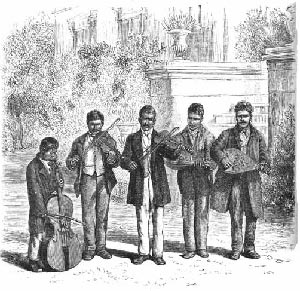 The Gypsies, or Tsiganoi in Greek, prefer the name Rom for themselves. The original name for the tribe that supposedly left North India in one of several waves between the 5th and 11th centuries was Dom. It seems that some of these people spent a longer time in the Persian speaking world than others and this certainly represents one point of division amongst them. Those known today as domari in the Arab world, especially Syria, Palestine and certain parts of North Africa, seem to have absorbed less Persian than others.
Another group called Lom developed a language known as Lomavren which retains little of its original Sanskrit related base. It is made up today of a heavily Armenian vocabulary. The third group, those that came to various parts of Europe, are known as Rom or Roma. Their language bears significant signs of Persian influence as well as borrowings from Greek and Turkish. These last two groups speak in a language influenced by Persian, although it is said that the Persian borrowings in Romani and Lomavren are not the same. This certainly would seem to indicate a fairly early divergence of paths rather than a later one, given that almost all scholars agree that Persia was one of the first stops on their way west. As for the time of their leaving India, there are many conflicting stories and it’s very difficult to draw any final conclusions.
It does however seem likely that the invasion of the White Huns into North India in the 5th and 6th centuries would have caused major upheavals which would have displaced considerable numbers of tribes, as would the Arab invasions of the 7th and 8th centuries. The most frequently entertained theory seems to be that of the Ghaznavid invasion of the 11th century under the command of Mahmud al Ghazni. The Ghaznavids were defeated about a century later by the Seljuks, and it is said that the Dom people, as they were then known, followed the Seljuk, Tatar, and much later Ottoman armies. They performed services such as sharpening swords etc. and many people ascribe the ancestry of the Gypsy trade of knife sharpening to this period in their history. Although, to be objective about it, no mention of this service of theirs is mentioned in any Seljuk or Tatar accounts of the time. There are other stories which are quite intriguing, but rather dubious, such as that of the Persian king in the 5th century who asked of his Indian counterpart, the Maharaja, to send him musicians to cheer up his population. The Maharaja apparently obliged and sent 12000 musicians of the Dom caste/tribe.
The Rom people, on arriving in Europe, are know to have deliberately surrounded their origin in mystery, often claiming to be Egyptian princes (hence the Gypsy, Gyftos etc names which are obvious perversions of the name Egypt-Egyptian). Indeed they claimed to be from “Little Egypt” which was probably meant to be somewhere in the southeast of modern day Turkey. All of this is very confusing and it is doubtful that it will ever be definitively sorted out. The strongest tool for analyzing their history still seems to be linguistics, which certainly does point to an Indian origin. One of the very first references to them in Europe is indeed a reference from a monk in 1322 of their being on Crete. They were also said to have founded a sort of an independent “state” in about 1360 on the island of Corfu. The word used by Byzantine peoples for them was Atzingan or variation thereof. This word may come from the name of one of the subdivisions of the original Dom people of North India, also known as Kikkan. (Editor’s note: This would also provide the root of the names given to Gypsies/Roma throughout most of Europe; in Greece, Tsiganoi, in France, Gitanes, etc.)
Gypsy Music, or the Music of Gypsies?
Concerning their music, this is a difficult and hotly debated subject. It is true that in almost all countries where they are found, they have played an important to dominating and decisive role in the local musical tradition. People have therefore asked the question “Is this Gypsy music, or local music played by Gypsies?”. Some people have offered the definition of Gypsy music as being music played by Gypsies for Gypsies sung in their own language. This produces problems because there are indeed quite a few different types of music sung by Gypsies for Gypsies in their own language that are very different the one from the other. Other people say that Gypsy music is whatever is played by Gypsies wherever they may be and that the way they play any type of music is invariably instantly recognizable from their style. This is pretty ridiculous because there are innumerable examples of Gypsy musicians who cannot be differentiated from other “locals” by any style or other such detail. It also would probably be incorrect to say that the further from North India that you find them the further they are musically from their roots. The music of Eastern Europe played by Gypsies or that of Upper Egypt seem to have little if anything to do with Indian music, whereas Spanish flamenco has some very eerie coincidences with certain North Indian idioms.
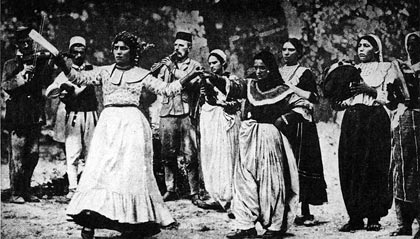
Our own idea to bring together Rajasthani Gypsies with Cretan musicians had nothing whatsoever to do with any historical precedent. Indeed Gypsies are not known to have had anything to do with Cretan music (unlike most other Greek folk musics where their participation and very important role is undeniable). It was simply something that seemed to me to be a good idea because they seemed somehow compatible on a purely musical level. The same could be said, of course, for countless other traditions which do not have any demonstrable historic connection.
Ross Daly and the Labyrinth Musical Workshop can be visited at https://www.labyrinthmusic.gr