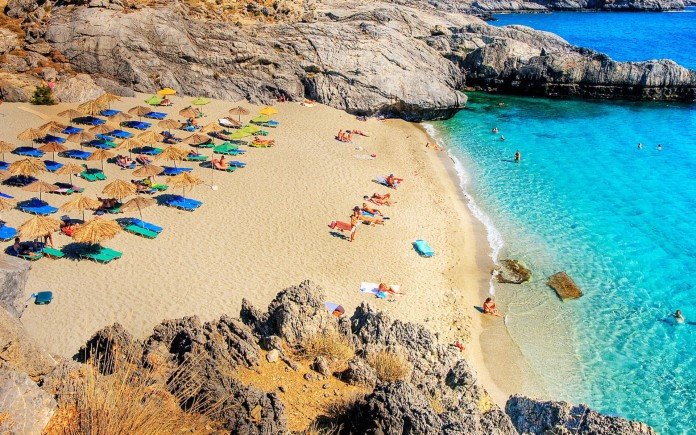
The waters of the beaches of Crete are of excellent quality, among the best in Europe, according to an annual report issued recently by the European Commission on the quality of EU waters. In fact, the commission reported that 99.9 percent of coastal waters of Greece are in top shape and are suitable for swimming. The testing was done in nearly 2,000 coastal areas throughout mainland Greece and its islands, and all them met at least the minimum requirement for cleanliness, while 97.6 percent were noted to be of the highest quality, meeting even the strictest criteria. In addition, all of the freshwater bodies of water tested in Greece also conformed to the EU health and hygiene standards.
Compared to the rest of Europe, Greece ‘s high score puts it at the top of its class. Of the almost 14,000 coastal areas in the EU tested, 96.7 percent were okay for swimming, and only 88.5 percent came up to the strictest standards. It was noted that some of the coastlines found unsuitable for swimming were located in Germany and the Netherlands , among others.
Waters were tested for five factors: total intestinal bacteria, fecal bacteria, petroleum, surfactants and phenols.
[quote_center]CRETE ‘S MESSAGE TO TOURISTS:
COME IN, OUR WATER’S THE BEST[/quote_center]
Meanwhile, as Greek waters were proving to be perfect for summer holidays, Prime Minister Costas Karamanlis was boasting of other positive developments in tourism – even going so far as to say that Greece has stabilized tourist arrivals, and that a steady increase is expected over the next few years.
At a recent press conference, the PM said the country was now registered as a tourist destination to most of the new tourism markets around the world. At the same time, he announced that museums and main archeological sites across the country will be open longer this summer as part of an effort to boost the country’s tourism industry following the Athens Olympics. “Starting in the first 10 days of June, all main museums will stay open from 8 a.m. to 7:30 p.m. at weekdays and weekends,” Karamanlis told reporters after meeting with top tourism officials. This is seen as a big improvement over previous tourism seasons when most of Greek museums and archeological sites closed at 2 p.m. , often leaving tourists locked out of important sites. Only the Acropolis closed at 6 p.m.
Karamanlis also noted that Greece was now promoting alternative forms of tourism in the country, such as spa and agro-tourism, while the ministry was even in the process of drafting a new legislation on healthcare tourism. He said the Tourism ministry would announce, in the next few days, the hiring of new personnel for Greece ‘s National Tourism Organization’s offices around the world. The agency currently operates a network of 23 offices, but plans to open another 49 new offices soon. He emphasized that Greece was now considering tourism as a main tool of economic growth and emphasized that the government has achieved much in its 14 months in office. “Ambitious goals have been set, many more are expected to be achieved,” he noted.
The PM’s optimistic outlook of “economic growth” couldn’t have come at a better time, for the tourism industry in particular – and the general population as well. According to a recent survey conducted by Athens University, young Greeks tend to be gloomy and insecure, uncertain about their future and worried about job prospects. The nationwide survey was conducted among 1,600 young men and women between the ages of 15 and 29. Fifty percent of the group regards unemployment to be the country’s worst problem, while most of them said that their main ambition regarding work was just to earn a good salary.
And, while 64.3 percent of the young people in the study said they felt proud to be Greek, the overwhelming majority, a whopping 75 percent, attributed that sense of pride, not to today’s current affairs, but to the achievements of the ancient Greek civilization – a culture that died 2,000 years ago!