Sheila, a second generation American Greek is looking for her family roots in Crete and finally finds them in Anogia
By Craig Leon
In the June issue of the Crete Gazette we printed the following letter:
[quote_box_center]I hope you can help. I am visiting Crete this June. My father was born there Jan. 3, 1898, and the town was called Peuriea, but I cannot find it anywhere on a map. Can you help? He left with the name of Omer Memakis and changed it to Albert Vardian, which is a mystery to my family. We are trying hard to discover the reasons behind this.
Sheila Vardian Yeo.[/quote_box_center]
We answered Sheila’s letter, providing some possible leads to family members. Following is the amazing and heart-warming story, written by her son, which began with that simple letter.
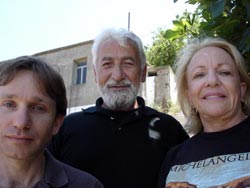
Born in Brooklyn, New York, to a mother from Poland and a father from Crete, my mother never thought twice in her 67 years about any special significance behind the name of her eldest sister, Helen. Nor did she ever question the origins of her father’s name, Albert Vardian, other than the possibility that he had shortened it from Vardianakis. Not, at least, until we started planning a family vacation in Crete, and mother decided to contact the Crete Gazette.
From the moment we arrived, that holiday became a journey into the past, a sort of magical mystery tour, filled with unexpected coincidences and wonderfully helpful people willing to translate, make calls to strangers in remote towns and travel along with us on our quest. And it would eventually lead us to the mountain village of Anogia, in the province of Iraklion, on a sunny afternoon on June 14, 2005 . On that day, answers to the 1912 disappearance of Dimitrios Memmos during the Balkan War, and the origins of my aunt Helen’s name, would become inextricably entwined. And my mom, Sheila Vardian Yeo, the youngest of three sisters, would find her roots – at least half of them.
The original mission was simple: a family vacation to a beach resort somewhere in the Aegean Sea or Dalmatian Islands. “Rhodes or Crete is fine,” my mom E-mailed me hurriedly between classes at Jupiter Middle School, where she is a 7 th grade teacher. So one miserable rainy April afternoon, when procrastination on a pending work deadline took the better of me and I wandered into a travel agency near my home outside of Stockholm, the unraveling of a century-old mystery began to unfold. The Fritidsresor , or “Free Time Travel” brochure I plucked from the shelf featured Caldera Beach Blue Village resort in Gerani, Chania, Crete, as the spanking new facility for sun-starved Scandies. Unfortunately, the resort had been fully booked for months.
About a week later, the Tickets travel agency called. “Mr. Leon, this is Helena from Tickets on Lidingö. I have good news. There was a cancellation for a six person condo at Blue Village Crete. I went ahead and booked it for you. I recommend you take it.” It seemed a bit pricey, but she insisted, “It is the only option I have right now.” Never did I imagine it was a critical step in a sequential unfolding of a mystery.
“Hi mom,” I called at noon Swedish time, crack of dawn Palm City, Florida, time where Sheila was getting ready for work. “Found a place in Crete with a huge circular swimming pool, aqua aerobics every morning, even Family Olympics!” I enticed her, avoiding any mention of cost. “Crete sounds fine,” Mom replied groggily, “but we are not much interested in sitting around a pool. We want to get out and see the Island. And eat Baklava!” Certainly, a visit to historic Knossos in Iraklion, where legend has it that King Minos kept a Minotaur in his maze, was a must, as were visits to crystalline Aegean beaches and ample samplings of Gyros and other Greek culinary delights.
As an afterthought, since Crete it was, Sheila decided to find out the name of the town where her Dad had lived before coming to America. Maybe, she thought, we could visit the town. The Certificate of Citizenship, the only official record Sheila had of her father, listed her father as Albert Vardian from Crete, with no other specifics other than Turkish as his race and Greek as his former nationality, an understandable anomaly given the war between the Ottoman Empire and Greece for control of Crete in the early 1900s when he had emigrated to America. My wife, Laura, General Consul of Ecuador in Sweden, suggested the best route was either a copy of the death certificate or to secure the background information of the naturalization paper.
Sheila wrote to the New York Archives on May 8th, providing her father’s naturalization petition number, and anticipating a possible name change from Vardian to Vardianakis to aid in their search. The response two weeks later from an archives technician was surprising:
[quote_box_center]…We examined the U.S. Eastern District petition of Naturalization #178672 and found the following information: your father Albert Vardian arrived into the United States under the name of Omer Memaki . . . His last foreign residence was Peuriea, Greece, and he renounced his allegiance to the State of Russia and/or The Greek Republic and/or The Republic of Turkey. [/quote_box_center]
With this information, Sheila tracked the passenger record of the S.S. Themostokles which confirmed that, indeed, an “Amer” Memakis of Turkish/Greek ethnicity from Crete had indeed arrived in America on July 17, 1916 . Where had the name Omer or Amer Memakis come from? Why would he have changed his name? Was he Turkish? Muslim? All this time, Sheila had imagined her father was Jewish. Admittedly, Sheila knew little of her father’s past, but this name had never come up. Her father had talked about riding Arabian horses. She recalls helping him clean the innards out of smelts, a common Cretan fish, and that he spoke French. And she remembers preparing olives at home as a little girl and eating calamari together. The man Sheila had known as Albert Vardian, alias “The Black Prince” – perhaps because of his tawny complexion and intense grey eyes – suddenly had another identity.
Sheila contacted Lou Duro, editor of the Crete Gazette, who found three families with the Memakis name, living in the township of Pyrgos, in the province of Iraklion in Central Crete, in the village of Amygdalos. We would use this information to contact them in Crete. Arriving at the hotel, Sheila’s husband, Fred, befriended Elena, Greek for Helen, who ran a car rental agency in front of the reception desk. She became interested in our quest, and offered to call the families in Amygdalos. She eventually reached Manolis, the eldest Memakis in the town, who explained that the origins of the Memakis family could be found in the town of Anogia, and that most went by the original Cretan name of Memmos, which was changed to Memakis under Turkish occupation, when ” akis” was added to family names. When he was told that a woman was looking for her “roots” the response of the elderly Manolis was literal: “What does she want those for?” Roots and olive trees, it turns out, mean the same thing in Crete!
At this point, we had more questions than answers. Where had Vardian come from? Was his real last name Vardianakis ? Had he adopted a Turkish name to escape the Genocide perpetrated by the Turks, then changed his name back to Vardian once in America? Or was his last name really Vardinoyannis, one of the wealthiest families in Crete? Or, were the families in Amygdalos indeed relatives who would receive us with open arms and recall all the details of Albert Vardian? Or , was Albert Vardian among the Turkish invaders of Crete who fled with his brother Ali when the Turkish invasion was stopped by the Greek revolution? So many questions…
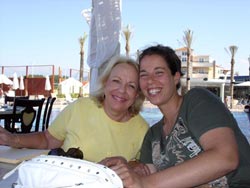
Elena urged us to go to Anogia to find the family. Meanwhile, Katerina, the sister of a friend of Sheila’s daughter, who coincidentally lived 10 minutes from our hotel in Gerani outside Chania, generously offered to help in our search for my mother’s roots, and to join us on this adventure, and help us translate.
She spoke again with Manolis Memakis, and contacted the Mayor’s office and anticipated our visit to Anogia. We were not optimistic about finding anything, as Manolis had no recollection of any family member immigrating to the United States in 1916.
After two hours of traveling winding roads, with her entourage of three generations of possible “Memakis” family members, including her grandsons David Sebastian and Alexander, Sheila made it to the city hall of Anogia, a fairly large mountain village of 3,500 inhabitants. “We are going to meet the mayor now,” assured Sheila’s husband Fred, half joking, as we entered the building. It turned out to be true! The reception we would get would be like, well, like long-lost family.
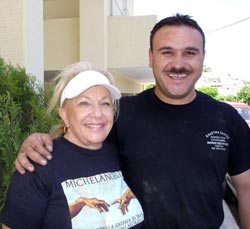
Upon entering, the staff of town hall was shocked by the physical resemblance between Sheila and the Memmos / Memakis family. They thought the same of me. The Mayor came out to greet us. The office called one of the Memakis family members, who met us at the town hall to bring us to meet the family. When we were met by Kostas, Sheila’s mouth dropped. “This is my nephew Larry!” she exclaimed. The resemblance was unbelievable. They hugged, and he led us to the family home.
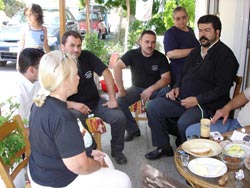
Energy of the history and the connections being made seemed to resonate through the town, and vibrate in the air. We were received with hugs and warmth and sun dried raisins with the stems still attached, and homemade goat cheese, and local spirits. And, family members continued to arrive all afternoon, with the curiosity and awe that someone had cared enough to search for her roots after all these years.
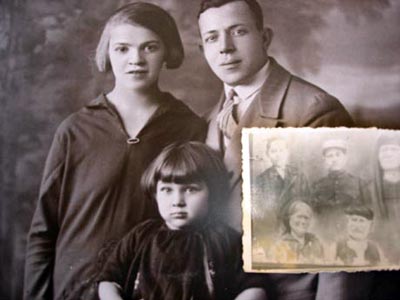
Word seemed to travel fast. Family, mostly dressed in black, mourning those who had died in the recent and not so recent past, continued to converge, developing into a huge family reunion of which Sheila and the rest of us were being welcomed with open arms as integral. The name “Dimitris Memakis” seemed to buzz, as photos removed from peoples’ walls, still in their frames, appeared. Upon seeing the photograph my mother kept of her father, circa 1926, the family seemed certain this was Dimitris – the young man who in 1912 had disappeared from the village, without any trace and who was presumed dead by 1917. “This is Eleni (Helen in English), his mother,” noted one family member, seemingly the matriarch of the family. “What is the name of your father’s oldest daughter?” she asked Sheila. “Helen,” she replied, the reality coming clear. My aunt Helen was likely named after his own mother Eleni, according to local tradition.
Evidence that Albert Vardian was indeed Dimitris Memmos became overwhelming by the uncanny resemblance between the photo of Albert Vardian that my mother had brought with her, and the photo the family had of Dimitris when he was 10 or 11. The shape of the face, the nose, the forehead, the hair, the expression – it certainly seemed to be the same person. He had left the village in 1912, so it was possible that it was he who arrived at Ellis Island in 1916 under the name Omer Memakis.
Why would he have changed his name from Dimitris to Omer? And why would he have entered with ” Alis ,” also a Turkish name, who he claimed to be his older brother, when the brothers of Dimitris had indeed remained in Crete and were accounted for? Perhaps they were friends, who ran off together looking for a better life in America. “It would have been impossible to leave with a Cretan name, because he would not be allowed out,” noted Katarina.
“He is definitely family“, Sheila thought when Vangelis, who was visiting from Athens, appeared. “It’s not just his looks, it is an attitude.” The family took us in, prepared for us a feast of lamb, beans, pasta, salads and homemade wine. Even the Mayor and Priest of Anogia joined in the lunch celebration. We toasted in memory of Dimitris, whose name had been kept alive through a third generation Dimitris named in his honor. They asked questions about Albert’s life, of our lives. They thought it was wonderful that Dimitris had made it to the U.S. as Albert, when they believed he had died during the war.
They talked about how the Turks had burned down their village twice and the Nazis once, and that the hardest part was not having shoes during the harsh, snowy winter season in this high altitude village 800 meters above sea level. They asked about Ali’s family, and about Sheila’s sisters Edith and Helen. So they were interested to learn that Albert had worked with my grandmother’s family making shoes. Most of all, the Memmos/Memakis family was impressed that Sheila would have the passion to search for her roots. They talked about their roots going back to the Venetian King Memmos. “This search is the core of everything that matters, the passion to find something you really value,” said George Memmos, who hosted the celebration.
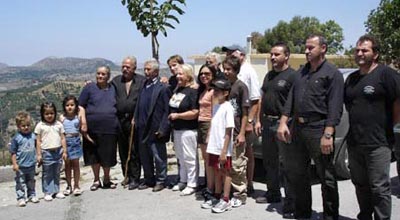
We may very well return to Anogia next year when Kostas plans to be married. And Vangelis, who lives in Athens and who happened to be visiting Anogia that day, assures Sheila, “If you get a phone call and someone says “Memmos, Anogia” it is me coming to America!”

Since returning to Florida, Sheila’s investigation continues. Upon reviewing the manifest from the S.S. Themistokles, inaccuracies abound. Since the 10 people before and after Omer Memakis were listed with “brown hair, brown eyes” chances are the U.S. Department of Labor immigration official never looked up as hoards of recent arrivals waited their turn for inscription. Had they looked up, they would have noticed his stark resemblance to Humphrey Bogart, with his tough guy stance and attitude, and the way he held a cigarette like it was a joint.
Sheila turns to me with a sparkle in her eye, “I was his baby. If anyone were to find out who my dad really was, he knew it would be me.”