Finger-pointing continues over polluted beaches in Gournes
By Lou Duro
While government officials and agencies continued to dance to the beat of the “blame-game” over the polluted waters in Gournes, tourists and locals alike have stood around all summer like wallflowers, deprived of swimming in one of the area’s best beaches, where posted signs, like this one on the right, served as a grim warning. And the beat goes on!
The horrendous problem was first made public when The Crete Gazette ran its expose of the slum-like conditions at the abandoned military facility in its last August editions. The story included a report on the long-broken biological processing plant which allows raw sewerage to pour into the sea. Although Gouves Mayor T. Blavakis, who represents the immediate area of the former U.S. Air Force Base, said, in a follow-up story, that the problem would be solved shortly, the situation continues to plague the local beach.
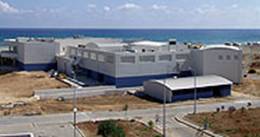 In more recent developments, the Governor of Heraklion, who in the past has denied any responsibility for the base property, has suddenly pointed his finger at the newly-constructed CretAquarium, which is due to open shortly, as a participating culprit in the pollution problem. The accusation was made in a letter from the governor to the Hellenic Centre for Marine Research (HCMR), which mysteriously found its way to all the local news media, and was based on the fact that the aquarium is testing the waters of its 32 tanks in preparation of its opening.
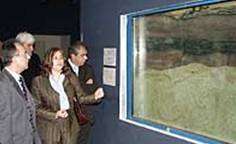 Professor George Chronis, president of HCMR, who hosted a recent private reception celebrating the placement of the first marine organism in the tanks, took exception to the letter, especially in the way in which it was presented, and said the governor was “confused” if he thinks the pollution stems from the aquarium.
“The letter from the governor saying that the aquarium pollutes the sea should have been sent only to us, instead of to all the newspapers,” Mr. Chronis said. “I want to believe that was a mistake.” He said that the centre, by law, is responsible for the quality of the seas, and is the only public agency which continuously follows pollution conditions.
“We have closely tested the water quality from the over-flow of our tanks from the very beginning,” he said, “and we will continue to do so until the installation of a pipeline is completed. All of these test results are available to the public. It is obvious the governor is confused about water being released from an aquarium with that of a fish farm. There is no comparison.”
Mr. Chronis said that all EU aquariums release overflow into the sea in the immediate area. As an example, he pointed out that with the Rhodes aquarium, the outpour of the overflow is just a 10-metre distance from tourist beaches, which are known for excellent water quality. “It is unthinkable to believe that the centre, guardian for the protection of marine environment, would violate the rules which it was sworn to protect,” he concluded.
Meanwhile, as the controversy continues, The Crete Gazette was told by a reliable source who wished to remain anonymous, that much of the pollution in those waters comes from hotels and, in some cases, even individual homes in the surrounding area, which let waste-water directly into the sea, by-passing private cesspools. “I can show you pipes which come up just a few meters from the shoreline,” the source, a life-long resident of the area, and a former employee of the military base, said. “The politicians don’t want to say anything about it for fear of losing local votes.”
Yannis Zidianakis, who runs the agricultural office for the Gouves municipality, refused to comment on the situation and referred all inquiries to the Heraklion governor’s office. “Mr. Kambanis (of the governor’s office) has all the latest data as to the current condition of the water,” Mr. Zidianakis said. He did confirm, however, that the waste processing plant is still not operable, and had no idea when it would be completed.
However, when contacted by this newspaper, Mr. Kambanis, of Heraklion’s Office of Public Health, said he has no information or facts concerning the base beach. “The testing was done by Athens, and the results are not yet available. We’re hoping to get a copy of the report by next month,” he said.
And, while the “don’t-look-at-me” and “finger-pointing” syndromes continue, someone surreptitiously removed all the “no swimming” signs. Does that mean the water quality has improved and is now safe? “No,” Mr. Zidianakis said emphatically, suggesting that they were probably removed simply because the season is over. However, he said the municipality had nothing to do with taking them down.
Perhaps whoever removed the signs is adhering to the adage, out of sight, out of mind . . . but they were not figuring on the “mind” of this newspaper. The Crete Gazette will continue to stay on top of this serious situation until it is corrected and the beach is once again safe for both local residents and tourists.