Tale of two worlds: Crete then and now
By J. Donald Oakes and Harris S. Parkell
The authors became friends while stationed at the American air base in Gournes in 1965. They both revisited the sight this year. This is their story, which was inspired by the Gazette’s recent articles of the former base.)
Arriving at Heraklion
[vc_row][vc_column width=”1/2″]
THEN: The cheapest ticket on the overnight ferry between Athens and Heraklion cost 90 drachmas — if you were willing to spend the trip outside on the deck with chickens, goats, crying babies, freshly-picked produce. As underpaid G.I.’s, we had no choice. Although we had enough money to drink to help ward off the elements, we did not have enough to ensure physical comfort for the trip. Consequently, we usually spent several hours at the bar inside, and then wound up stretched out on deck for the remainder of the 12-hour trip. Fortified with Minos wine and ouzo, spending the night on deck wasn’t much of an inconvenience.
In those days, the old Venetian fortress located at the end of the breakwater in Heraklion was the first recognizable thing one saw upon arriving. After the trip to Athens, it was like a feeling of “I’m home.” At the very least it gave us a sense of “being back” where we belonged at that point in our lives.
It was at those times; late at night and early mornings, that Heraklion harbour was silent darkness around us. There were only the faint sounds of manned fishing boats, preparing to set off for the day’s catch, and, occasionally, during the summer months, a luxury liner was docked.
[/vc_column][vc_column width=”1/2″]
NOW: In September 2005, we travelled to Heraklion, wanting to visit a past that doesn’t exist any more. Four decades have come and gone since our Air Force days of the mid ’60’s. We knew that Crete had undergone dramatic changes in the intervening years. However, we had no idea just how prevalent those changes were. They first became obvious during the ferry ride from Athens, where we had once travelled “deck class.” This time we arrived via luxury ferry from Athens in a trip that took only nine hours!
The 26 Euro ticket, plus the extra cost for obtaining a private stateroom with a shower, was a small amount to pay. A bit different than curling up on the cold deck 40 years ago. Other amenities, like a lounge area with closed circuit television, upholstered chairs, a disco and a first-class restaurant, were available.
We arrived in Heraklion Harbour at the break of dawn. Our eyes scanned the still-darkened water for the first glimpse of the lights of the city, and, of course, the old Venetian Fortress, to establish that “we were back.” But, as we approached and then passed the end of the breakwater, there was no fortress! Could it have been torn down? We didn’t think it likely but stranger things have happened in the name of progress. Then, as the ferry continued its slow pace, we suddenly realized that the harbour had been expanded over the years, and at last the fortress loomed on our right. We were back!
While the fortress remained the same, there were many other changes besides the expansion of the harbour. The same area, so peacefully serene forty years ago, was now bustling with early morning chaos, traffic and noise. The quaint harbour was now strictly a yacht basin with an occasional small fishing boat. Ocean-going freighters, ferries and cruise ships now docked at a huge adjacent area that had been built since our last visit, disfiguring the entire area almost beyond recognition.
[/vc_column][/vc_row]
In the Center of Heraklion
[vc_row][vc_column width=”1/2″]
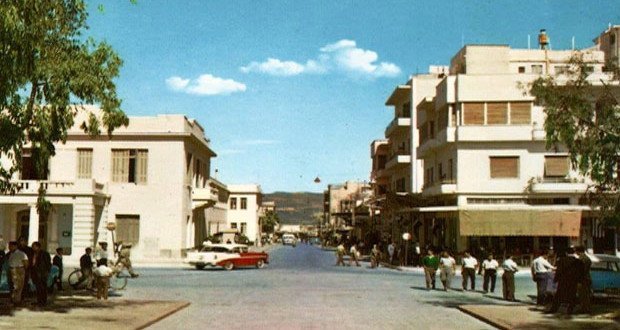
THEN: In 1965, the Morosini Fountain in Lions Square was a perfect spot to change direction as we caroused through town in a 1951 Jeep. It was sort of the epicentre of Heraklion. All tourists turned up there sooner or later, as did all most of the G.I.s who ventured off base. Sometimes as we were leaving, and just for a lark, we’d hop in the jeep, careen around the fountain with a burst of speed, coming dangerously close to people at the outside tables, then reach out and snatch bottles of booze or beer from the alfresco tables at the Caprice Cafe, and then roar off down the street with gales of laughter. Our “getaways” were easy, as local police in those days and were on foot, and only armed with a “whistle” – not much of a deterrent.
Occasionally, on an endless quest for fun, adventure and dates, we frequently walked the seven blocks from Lions Square down 25 Avgoustou Street to the waterfront and back. We might do this 2-3 times a night, checking whether a tourist ship, packed to the rafters with single girls, had arrived. Being the first to mingle with these girls allowed us our pick of dates. Step 1 was to get them to a caf? for a drink, gain their trust, then reveal the existence of the Jeep and promises of fun during the next several days of their visit to the island.
[/vc_column][vc_column width=”1/2″]
NOW: After disembarking and a short taxi ride to the fashionable Lato Boutique Hotel, we stowed our luggage until check-in time. Then, hungry, we walked to Lions Square. From our hotel on Epimenidou Street, it was a short distance.
What used to be an easy walk, both down to the harbour and back up 25 Avgoustou Street had suddenly become exhausting. Somehow, over the years, that street has become significantly steeper.
Awed at all the activity, we ate breakfast at the site of the former Caprice Cafe. The entire area has become a pedestrian plaza. Lions Square encompasses numerous restaurants and tourists shops. Even Minos is a thing of the past. It has been upstaged by Raki. Where was the Crete we knew?
[/vc_column][/vc_row]
The American Base in Gournes
[vc_row][vc_column width=”1/2″]
THEN: We had been stationed at the American Air Force base near Gournes, about 30 kilometres east of Heraklion. Although barely in our 20’s, we were saddled with enormous responsibility. On base we worked as intelligence analysts in the Operations Building, located in what was called the “compound,” a heavily guarded fenced area. This was, after all, the height of the cold war. In short, we were spies. Code breakers. Nothing happened in that part of the world that we didn’t know about.
As diversions from the stress at work, we had clubs for drinking and dancing, a bowling alley, cinema, snack bar, gymnasium, photo shop, clothing stores and supermarkets, and a beautiful base beach. In short, Iraklion Air Station was a mini-city. Gradually, the need of the air station dissipated. As electronic technology developed, the need for our type of “mission” became obsolete. Ultimately, in 1993 the base was abandoned and turned over to the Greek government.
[/vc_column][vc_column width=”1/2″]
NOW: The base is mostly derelict. What had been the BX and snack bar is now Gouves City Hall. My barracks is now an administrative office building for a Greek vocational school and my room in particular is the principal’s office. Although construction work is being done to some of the barracks, most of the buildings are forlorn. Glass from broken windows and trash from squatters litter virtually every floor in every building. Wiring is exposed and insulation hangs from the ceilings. The clubs today are unrecognizable. If the bowling alley did not still have a prominent sign, its former purpose would be unknown. There is nothing inside indicating what it had been. The chow hall, however, still looks as though it is a chow hall, thanks mainly to the tiled areas of the serving line. It, too, has been vandalized. Most of the seats in the movie theatre have disappeared.
Walking through the unmanned gate is surreal. No one is there to check badges. Gradually it all came back. The entrance hallway, the door at which we had to punch in a four digit entry code, the areas where we both had worked, and the “burn room,” in which all classified paper was burned daily, still with the old furnace untouched by time. It was obvious that squatters had lived in the Operations Building over the years. The only evidence that Americans had once used this building were occasional signs: the entrance to the burn room still warns readers how to handle classified information, DataComm and Criticom Support Facility signs telling visitors which part of Operations they’re in.
[/vc_column][/vc_row]
Roads and Traffic
[vc_row][vc_column width=”1/2″]
THEN: One of the greatest joys as a G.I. on Crete with personal transportation in the mid ’60’s was the fact that there were very few vehicles with which you had to contend. There were, of course, numerous taxis in Heraklion, plus a few large trucks and only several buses. Only a handful of people owned motorbikes. For the most part, roads were in good shape due to the absence of heavy traffic.
The few Greek drivers were men and always courteous. No one ever seemed to be in a hurry, except possibly G.I.s upon hearing a tourist ship had docked. Although the only road between the base and Heraklion wound through the mountains, there was no apparent need for a guardrail, and the trip from base to downtown took about 40 minutes.
[/vc_column][vc_column width=”1/2″]
NOW: After renting a Suzuki, we made our initial foray to Gournes, a trip we had driven countless times in the past. During the planning for our trip to Crete, there had been a certain amount of smugness. Because of our vast experience on the island, it was unthinkable that finding our way around could possibly be a problem. We were in Heraklion and base was about 30 kilometres east, past “Florida” Beach. We had, of course, driven that route 500 times. Go out past the airport and just stay on the road. You can’t miss it. Famous last words.
The first problem was getting out of Heraklion. What had been two-way streets years ago now were one-way. Traffic was routed in directions we didn’t want to go. Because Heraklion is such an old city, streets are very narrow, and can mostly accommodate just one lane of traffic. Unfortunately, the Greek drivers seem to think that there should be two lanes and they will pass you. When traffic is jammed to a halt, adventurous motorcyclists creating a third lane bypass what had become two lanes of traffic. Sidewalks often do double duty as a passing lane for motorized traffic. Greeks as a society have not been driving a very long time. The concept of “slow” and “take turns” and “patience” have not, as yet, made their way into the culture.
Finally, we managed to get out of town. Unfortunately, we were on the New National Road. This new road is actually a two-lane highway. Again, the Greeks perceive the shoulder to be a “slow” lane. If you don’t move over and drive on the shoulder, they will pass you, either on the right or on the left, or on curves. They will not stay behind you no matter your speed. The trip to Gournes took only about fifteen minutes. It came so fast that we missed it and had to turn around. Most stunning of all was seeing women, both young and old, driving. By the end of the first day on the island, it was apparent that motorcycles were the vehicles of choice among many Greeks, both male and female. Virtually every bit of videotape shot during our visit has the sounds of the ubiquitous motorcycles drowning out everything else.
[/vc_column][/vc_row]
Women in Crete
[vc_row][vc_column width=”1/2″]
THEN: Forty years ago, Cretan women traditionally wore the long black dresses so common in that part of the world. The only skin visible on them was their faces and hands, assuming you could get close enough to observe.
In those days, husbands and fathers were very protective of the females in their families. Socializing between young Greek ladies and American G.I.’s was basically frowned upon. So, to discourage interest, young women dressed like their mothers and grandmothers. On the rare occasion when socializing did occur, there was an elaborate dating ritual that involved the entire family going on the date with the young couple.
As the Greek family built trust in the G.I., one by one family members would discontinue joining the dating couple. Ultimately it would be just the father and mother with the young couple, then finally the father with the couple. When the girl’s father ceased joining in on the dates, the couple was considered engaged! And they had better marry! (The story was told of one G.I. who, after refusing to marry his Greek girlfriend, was shipped off the island in a mail bag in the middle of the night to avoid angry relatives. True? No one is certain. However, most of us learned a lesson from the story.)
[/vc_column][vc_column width=”1/2″]
NOW: Sitting at Lions Square that first morning, we could very well have been in New York City, San Francisco or London. There were so many people – thousands of people, all scurrying to begin their day.
The most noticeable change at that moment concerned the young Greek women. They all are dressed in jeans and short tops. Each one of them exposing her bare midriff! As it’s the fad in London, Munich and New York, so, too it’s in vogue in Crete.
[/vc_column][/vc_row]
Restaurants in Heraklion
[vc_row][vc_column width=”1/2″]
THEN: Living on base usually meant eating in the chow hall three times a day or, if one had a little money, possibly a quick meal at the club or snack bar. Although the food was nothing special, we knew it was prepared in a clean environment.
Off base, though, it was a different story. Sanitation was not a high priority back then. All G.I.s noticed that meat and poultry hanging on Heraklion’s Market street wasn’t refrigerated, and were covered with flies Even at Caprice Restaurant and the nearby Minos Hotel, plates sometimes were dirty. Certainly ouzo glasses weren’t always clean. (This lack of sanitation did not always deter us. We simply figured that the potency of ouzo killed any unwelcome bacteria.)
Before tourism became such a huge industry, menus were generally in Greek and one could not always be certain what one was ordering. Accordingly, most meals were eaten on base. Gastronomically, downtown Heraklion mostly was limited to supplying souvlakis for the more adventurous, and an occasional pastry.
Every G.I. who enjoyed hanging out downtown is familiar with what were appropriately known as “bomb sites” (especially if you made a night of it drinking at Caprice’s. A bombsite, simply, was a hole in the floor, which was supposed to be a toilet. Everyone has a personal story to relate, but no matter how grim it sounds, you can bet reality was considerably worse.
Bombsites were usually found in restaurants, tavernas and even small hotels. On either side of the hole there were places to position your feet as you squatted (if you were so desperate that you couldn’t wait until you got back to base). Then you just plain hoped for the best. It was usually painfully obvious that the last twenty people who used it previously had missed the intended target.
Bombsites were always absolutely filthy, reeking with an odour that would make your eyes water. The first time you saw a bombsite, you would stare in amazement then close your eyes, trying not to breathe while taking care of business. By the second time, you would have learned to gulp as much air as possible as you approached, hold your breath while hoping and praying that you could finish your business before needing more oxygen. Alleys were definitely a preferable alternative when your need was simply liquid, which explains why so many Greeks relieve themselves alfresco.
[/vc_column][vc_column width=”1/2″]
NOW: Today, everything and everybody is clean and very modern! Even most of the toilets are ultra-modern. No more disgusting “bomb sites!” — except in some remote villages. We were struck by just how up-to-date some of the places are. Using the bathroom of a restaurant on Market Street, it was amazing to see motion detectors switch on lights as we walked through a hallway towards the men’s room.
All bathrooms, from our hotel to every restaurant we patronized, were absolutely clean and fresh. At the restaurant now occupying the former location of Caprice, the infamous bombsite is no longer accessible (assuming that it still exists downstairs). Patrons now go to the second floor to more modern, clean facilities.
[/vc_column][/vc_row]
Small Towns in Crete
[vc_row][vc_column width=”1/2″]
1965. There were never any dull moments when we explored the small towns of Crete. Our curiosity was always aroused as we travelled, absorbing the sights and sounds. The vineyards and olive groves were obviously the main source of income for the people living away from the sea. We would stop and marvel at the sights when the farmers harvested their bounties. Invariably they would motion for us to help ourselves and we gladly accepted their invitation.
In such cases, we could not understand them when they spoke and they could not understand us. Words weren’t important. There is something universal about the language of smiles and hospitality! After helping ourselves to more than enough grapes, we would venture on in search of the village’s taverna. Again, we were always treated with warmth.
[/vc_column][vc_column width=”1/2″]
2005. Wanting to recapture the same feeling of forty years ago, a few days after arriving in Crete we drove through Panagia, a small village near St. Nicks and accidentally found a vineyard high above the town. By sheer good fortune, it was harvest time.
As we passed, we saw a man with his family cutting grapes. After motioning in sign language for permission to videotape them, we were given several pounds of grapes. Although they expected nothing from their American visitors, we gave them €5 in appreciation of their willingness to allow us to photograph them.
Afterwards, we drove into town to find an “old fashion” taverna. It was easy to do. Finding the “perfect one” in the exact centre of town, we “enjoyed” our customary ouzo and shared laughter with the locals. Again, not a word was understood. All we needed were smiles to communicate. That genuine friendliness is even rarer today. We had found our Crete!
[/vc_column][/vc_row]
[vc_row][vc_column width=”1/2″] [/vc_column][vc_column width=”1/2″]
[/vc_column][/vc_row]
[vc_row][vc_column width=!”](J. Donald Oakes www.stumpsonfire.com and Harris S. Parkell www.iraklion-able.com were two “unlikely” friends who became close buddies while stationed with the U.S. Air Force at Gournes in the mid sixties. Oakes was a “Southerner” from Alabama whereas Parkell was a “Yankee” from New Jersey. Oakes is the author of the autobiography “The Stump’s On Fire And I’m Naked” and Parkell is a former writer for United Press International. They are planning on collaborating on a new book covering all their adventures in Crete.)[/vc_column][/vc_row]
Great times, from 1965-67 with Bravo Flight. I also had wonderful experiences with the Airmen’s Club band, with Tom Spears, Howie Smith, and Tommy Knight.
What a great year-and-a-half!
Great read. IAS from February 1968-September, 1970, as a 202. Recognize the city you described a few years earlier, also heard the “mailbag” story while there, and returned to Crete for a visit in the early 1980s. Promptly got lost on the new road looking for the base and Hersonissos, where I spent some time, tried to understand the hotels that popped up at Malia, where all the windmills went. I too, in time, found the Crete I remembered.
j9r168 I was on Charlie Flt. Oct 70-72, X1. MY name is Donnie Pierce. Pants was the nickname everybody called me.Hawk and I had an apartment in the Village. Email’ [email protected]
Enjoyed reading this article on your trip back to Crete. It sure brought back many memories. Know from previous articles read that the base is now in shambles.. The modern era is now upon the island but the memories of being stationed there will remain.
I was born at the IAS January 1960. My dad was stationed there 1958-1960. We left when I was 9 months old so I don’t remember anything about IAS. It is good to see in pictures what I missed. My dad does a good job of describing but a picture IS worth a thousand words. Thank You
I was stationed on the island from 1957-1958. Part of my duty as a support person was as the life guard on the newly opened base beach. My office was located in the rec hall near the base exchange and my living quarters in the barracks just across the street. The base was much smaller (building wise) than what I see on YouTube. The base housing at that time was a collection of house trailers. Some of the most enjoyable times of my long life happened while stationed there. Iraklion was very much a small town even thou there were some 80,000 people. Looking at some of the film of the NOW roads to and from the base I remember the small ribbon of highway we used back then. I have always wanted to return for a short time but seems there was always something else getting in my way. I envy those of you who were able to do so. Most of my old buddies are most likely gone now. but just in case email me at the following. [email protected]
Wishing I had made the trip. Max Davis
My family was stationed at the base from 72-74. Was 9 when we left due to the death of my father in a motorcycle accident. Still have wonderful memories of living downtown until base housing was available. Still have my sun hat from those 100 plus degree days. My hat says trailer 639 in case it got lost. Very fond memories.
Great article. Brought back many memories. I was a ditty bopper on Crete from June 1960 till Jan 1961. Great people and so friendly. many happy afternoons in the square in Heraklion. 30 dracs for a nice steak dinner. Beautiful scenery and, taking a jeep to small villages in the country side were some great days.
Thanks again for bringing back so many memories
Enjoyed your story. My dad, Jerome, worked in crypto. We were there 68-70. I was 5. I remember hiking up to the big cross, being in the cage crib at the 2 bed base hospital. “Jimmy the Greek” who worked in the hospital would sneak across to the chow hall and bring me french fries! My only question is….How many floors underground was the crypto building? Dad died in1986(10 yrs) after retirement, never talked about his “job”. Wasn’t until later that I found out what he did for 20 yrs!
I was stationed at IAS from November 1958 to May 1960. Not much there in the line of recreation at that time. Base theater and bowling alley were in the planning stages so the tour went from 12 months to 18 just as I arrived. We did have a base gym though and an airman’s club. In the summer we also had the beach sans any lifeguards or any other frills. Just an area to lay your towel and soak up the sun and view “dragon” island. I worked in the compound as a morse intercept operator on Charlie trick. The only green on the base when I arrived was the “pickle grass” that was called the lawns in front of the buildings. One day sometime into my tour, the base commander (Col. Shean) decided he wanted to hold a base beautification project and plant 10,000 trees and shrubs on the base. What fun! Everyone on base except the watch on duty at the compound was required to participate (including myself and the rest of Charlie trick who had just completed a mid shift.) Good ole day workers lucked out again! Charlie trick got the job of going to the base sewer plant for the fertilizer part of the project. I don’t know whether the 10,000 goal was ever made but looking at some recent pictures, it looks like some made it. I have a lot of good memories of the friends I made during my Crete tour. I had just joined the air force and was 19 years old.
Was a 207×2 at Ias sept.74 tilMar76.Able Flt.drove a yellow vw bug.Joe Gaines and John Cihota and Danny Martineziii from Toledo Ohio were my supervisors. I played fastpitch, football, basketball and vollyball. Champs in fastpitch and football.enjoyed lots of friendships loved the island, trips to Athens on deck class.round trip for yellow submarine&me $18.”wow”.
Enjoyed reading your story of then and now. I feel like I have been back there. I was at IAS from Aug 1965 to Feb 1967 and had a great time.
Like a lot of us I spent 18 months on Crete in the early 60’s, remarkable as to how things have changed in the quaint little town and on base as well. Thanks, a great read.
Thanks for the article. I left Crete in ’66, was back their briefly a few years ago but didn’t try to see the base. A cruise I’m taking from Istanbul will stop at Iraklion for day.
I think I’ll try to get out to the base at Gournes, Florida Beach, and Lions Square.
It was so long ago, but in 1972 I was on a bus trip from London. I was one of those hippy back packers that travelled all around Europe. After one look at the beaches of Malia I unloaded all my stuff off the bus and stayed in Malia for more than 6 months.
I did a lot of travelling around Crete and will always remember my evenings at Yannis Cafe listening to Rod Stewarts Maggie Mae that seemed to play continuously…..
Irene G. from NY? Is that you? I lived in Malia for 39 months. VW bus. 2nd floor apartment. Samaria Gorge without boots. Loaned you socks.
Thanks so much for the wonderful article. Your memories and mine are amazingly similar. I was a Russian interpreter on Dawg Flight 1966-67 and have, like most others, just very warm and pleasant memories of those years of my life. Seems like I spent most of my time between being on the base or on the beach at Malia and of course many evenings in and around Lion’s Square.
Although I did return a couple of times in the 1970’s, I haven’t been back since then. I have seen the pictures of the deteriorating base facilities and it just seems sad.
Glad to hear, though, that the same open friendliness of the small village Greeks has been maintained.
Something about simple goodness that endures even though all else changes.
Thanks again.
I was on Crete from 1959-61 (I was aged 7-9) with my family. My dad was stationed there and I remember him trying to teach me Morse Code and I thought that was the coolest thing. My mom was in several plays at the theater (Arsenic and Old Lace was one) and I saw my first scary movie there – The Mummy, starring Boris Karloff. My oldest brother Dave hung an ace bandage on his arms and wrapped one around his face that night as he staggered into my room, moaning! How could I ever forget that!
We lived just outside of Iraklion overlooking the old harbor (it’s gone now as well as our house). Our house had a stone wall surrounding the yard and one area had been used as a firing squad wall during the Gernam occupation. My brother dug our many of the shell casings and put together a great “Show and Tell” display for school. I have such wonderful memories there – not as an adult like most of you but as a child living the most idyllic life imaginable – swimming in the warm sea, sitting on my dad’s lap at the snack bar, watching my brothers play tennis at the courts, walking the long road down to the beach, being the only one of my friends who could swim all the way out to the floating platform and flirting with all the cute airmen at the ripe old age of 8.
I was able to return to Crete in June 2011 – I tried not to get too excited as I knew it had changed dramatically and that my childhood memories might not be accurate, but I was amazed at what I could remember. We drove to the harbor and took pictures by the old Venetian Fort, visited with Greek sponge divers who offered to take us to Dragon Island at no charge.
We walked up the streets to Lions’ Square and I took off my shoes and walked through the water to sit on the fountain as I did 50 years earlier. We drove out to Gournes looking for the base and hearing that there was only an aquarium there now but suddenly coming upon the old gate, I let out a cry! I recognized it! The gym, theater, tennis courts, and snack bar are still there – but in horrible shape or the snack bar being used as an office. We went inside the theater and I took pictures for my mom who is still alive at 88 years of age and very healthy.
I wish my brother Dick could have been with me as he could have pointed out so many things that I wasn’t sure about. And I wish my dad was still alive as I would have loved telling him that I finally was able to return to Crete – 50 years to the month after I last was there.
Thank you for your wonderful stories – you awaken memories from an 8 or 9 year old mind!
from Jean Legas Allen,
brothers – Dave, Dick and Alan, Mom – Marge, and dad – Sherman
You did a wonderful job on your story and I am looking forward to your book…there is something special about Crete.. it changes you in ways that you don’t always appreciate until much later… the things that we complained about.. no TV, McD’s and mail order clothes (at the time) and the simple are the things that most people seem to miss the most.. It goes to show you.. sometimes progress isn’t always that great… yes, we welcome sanitation but long for simplicity and the relationships that you make..outside of your usual “circle”. These relationships are so rich and rewarding and is what I miss the most…
Thank you for sharing.. Christi Jones
From 4-67 to 9-68 I was ‘chief newscaster’ at AFRTS, Iraklion. In those days, ‘dates’ with my cute Greek girlfriend had to be ‘clandestine’ and away from Iraklion. The overthrow of the monarchy by the ‘junta’ raised tensions greatly and at the TV station we had ‘visits’ by Greek officers, literally looking over our shoulders as we worked.
Remember when Greece almost went to war with Turkey over Cyprus? I nearly got arrested for taking a few snapshots of Greek fighter jets parked on the commercial air strip as our Air Force bus rolled by it.
Spent a lot of drachmas sipping ouzo at ‘Pop’s in Iraklion, but at least, unlike one airman, I didn’t fall off the balcony. Unforgettable memories. Thanks for sharing yours.
Aravis96,
I’m sure I know you. I worked part time at AFRTS at Iraklion in 1968 until I got transferred mid-term to Brindisi, Italy. I loved being on Crete and have fond memories of my friends at AFRTS, road rallies, the beach, and the beautiful country.
I was disappointed at being transferred from Iraklion to Brindisi. It was a great tour and I would have gladly extended.
Not long ago I looked at Iraklion on Google Earth and was surprised to see some of the buildings still there unlike the air station at San Vito in Italy, which has been turned into what looks like open farm land.
Great memories at both but Iraklion was the best.
Thanks for your story.
Brian J.
What a beautiful story! My husband and I just returned from our walk down memory lane. We were stationed in Crete ’82-’84. Kaz worked in the compound…I worked for the 2115CS.
Although our hearts were broke with the condition of the base…we still found so many familiar sites: our home in Kokkini Hani, the clinic where our son was born in Iraklion, and the sheer comfort of being “home”. It was a wonderful weekend and we can’t wait to go back. There is no place in all the world like Crete…
thanks for sharing your story
Thanks for the memories. You’ve captured a lot of what those of us who were stationed there experienced in the time of IAS Crete. Some of the best (simplest?) times of my life. I arrived at IAS on February 5, 1966, a wide-eyed, never-been-anywhere, 18 year-old kid from Everett, WA. Returned to the “States” in September, 1997 after being “extended “ a month due to the “97 Mid-East war (boy was I pissed-off with those guys!).
I was “Easy Flight”, auto morse. Memories include scaling the “mountain” (the one with the big cross) overlooking the base – Jack Daniels in hand! Didn’t spill a drop. Got pictures! Bus trips to wine festivals and up to Khania, to an orphanage the people of the base were helping, bowling (6 lanes!), occasionally driving golf balls from the “driving range’, softball games down at the diamond by the beach, sailing a small catamaran sailboat from the “marina”, sending home gifts from the BX, hitting the ditch after a night at the Airman‘s Club.
Memories of taking laundry up the road to the small village nearby, where a sweet ol’ lady would take our duffle bag full of “dirty clothes” and clean it for a dollar. She wasn’t using a Maytag either, in fact I think she was using the rocks in the stream beside her home! Underwear was clean but this was before the days of fabric softener! Anyway, the really cool part about this old lady was she would invite us into her unheated, no running water, immaculate home and offer us a shot of oyzo (s’eyia! or something like that). Gracious, big-hearted and just plain cool. Those were the days…..
Again, thanks for the memories guys.
Was stationed on Crete from Dec. 1968 till about June 1971. My wife and I lived downtown. Was on Charlie Flight as a morse code operator. Loved my time there and really miss the friends we made while there.
My family and I were stationed at Iraklion AB from June 1970 to June 1972. My dad (Sgt Jimmy A Coley) worked in the compound as a “ditty bop”. Some of our best times were on the island of Crete.
My family was there from 68-70, My dad was a medic. We lived at Hersonisis for a year until they build the base housing. I loved Crete, have so many memories from that time. My dad even bought me a donkey from the gypsies, rode around the small towns on him with my friend Teresa Zavislak. My dads name was George Wallace, he passed away a few years back. I love reading these posts from people who had been there around the time we were. It will never be the same but memories last forever
I was the Dental Hygenist on Iraklion 1969-1972 and I remember” Jimmy the Greek” quite fondly. He was married to the secretary, also Greek, in the Hospital. The Dental Clinic was attached to the Hospital and had 2 Dentists, Two Dental Assistants, One Dental Lab Technician, One NCOIC and me.
Joannie, we lived two doors down from you and your family. You were about 12 if memory serves me correctly. I think you were in the “B” unit and we were in the “D” unit. WOW little Joannie you used to baby sit with out 2 daughters…Lori and Michele.
If you would like to email I can tell you more about Crete, your family and Lori and Michele. I would definitely love to hear about you. [email protected]
We were there from Aug 69- Aug,72. I arrived being pregnate and left the same way.
Our best assignment. My husband worked in the service club. We wanted to go back for a visit, but 5 yrs after retirement, Reece was left totally handicap due to an accident at work. Traveling is very hard for him, so we really enjoy seeing and hearing about Crete.
With any luck, you’ll see this posting! I think it was you guys who gave me my Broadman Hymnal about 1970. I probably last saw you two during 1972. I was discharged after nearly 3 years on Crete in Nov 1972. Went home to Minnesota. I’ve also lived briefly in CA & AZ. Tomorrow I turn 75! I’m in Phoenix but moving to Minnesota soon.
I was on Crete late 68 to may 72 . On Charlie flight and an X-1 Morse code operator too. Great tour and I would love to go back.
I was stationed at Iraklion Air Station and assigned to “Charlie Flight” from Dec. 1968 until Aug. 1971.
I had the very distinct pleasure to be able to return to Crete during the months of May, June & July of 2008. I visited I.A.S. on three different occasions to document the changes that had taken place on the old base.
I am planning to return to Crete for another three month visit during the months of August, September & October 2009.
There is just something special about Crete, its people, it history, its culture, and the many memories of having worked and lived there so many years ago.
We were stationed in Iraklion, Crete from 1969-1973. My dad was Tsgt. Clyde Orr. Best 4 years of my life. We lived off base the first year and then on base in the trailer park with a lean to. They were still building the new base housing at that time. So many wonderful memories… Lion’s Square, Mike’s Lighthouse, the beach, Dragon island….. Small world, my brother met a lady 10 years ago while at a reunion. She lived in Crete with her family from 1967 – 69. They left just before we got there.. They are now a couple and talk about Crete all the time..
My dad was stationed at Heraklion Airforce Station from 1969 to 1971, we were the first ones to move on the base when the new base housing was built, before that we lived over a Greek bakery in Knossos. i loved it there and now i see pics of the base and almost made me cry, one day i hope to go back and visit for awhile.
Thanks for the memories.