The Roma of Crete
By Louis Tracy
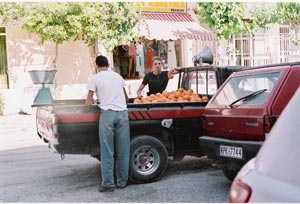 They have been living in Crete since at least 1322. Families can be easily seen selling rugs by the roadside. Children are conspicuous in most centres, playing accordions and drums for pennies. We see them in the market, men and women, offering any amount of cheap clothes, shoes, fruit and vegetables, bric-a-brac, to passers-by. We often come across the wide-eyed eight-year-old, asking for five euros for a balloon, and reluctantly taking less. What life does she have? What impressions do we take of these people who live amongst us, these Tsiganoi, or, in English, Gypsies? If you have any curiosity, you may wish to see beyond the colourful clothes, the ragged appeareance of the children. You may want to hold the gaze of the Tsiganoi for a moment, and ask why life for them is so different to the mainstream, so separate from most of us.
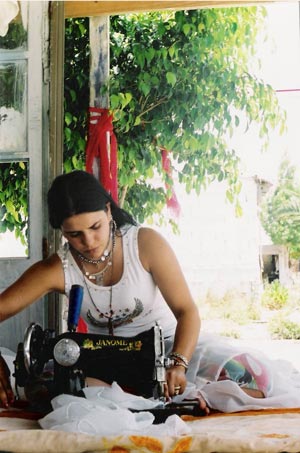 An exhibition in Heraklion, ‘Through My Eyes’, has gone some way toward opening up the world of the Roma, the preferred name of the Gypsies, of Crete. Beginning in early December and running until the 10th of January, this simple, powerful show of photographs, with twice-weekly seminars, raises as many questions as it attempts to answer, but cannot fail to challenge preconceptions about the Roma. An accompanying filmed documentary, still available, is a moving portrayal of life in Crete’s largest ‘camp’, at Alikarnassos, outside Heraklion. The settlement, maintaining at least six hundred people, has existed for twenty years and has successfully challenged attempts at forced eviction and years of systemic racism. Six homes were burned to the ground, according to Helsinki Watch. The camp survives without running water and electricity. Direct appeals to the European Court of Human Rights, with support from organizations such as Greek-Helsinki Monitor and the International Red Cross have ensured its continued presence, although conditions are still desperately poor. Basic services, such as education, medical care, attention to hygiene and rubbish collection are almost non-existent, although notable efforts have been made to offer some amelioration. A scandalous lack of recognition of human needs takes place every day, here in Crete. The accepted truth, as I have heard it, is that Gypsies don’t want to change. And yet we, in general, know nothing about the people living at this end of the social spectrum. The Historical Museum of Heraklion has made an exceptional move toward understanding the situation, with this exhibition. It gives a ‘voice’ to individuals from a hidden community who have thus far been virtually silent.
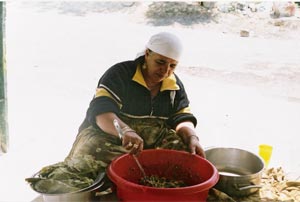
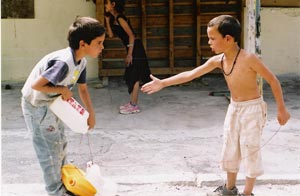 Quite simply, a period of training in basic photography was offered to a number of Roma from the camp. They then went away and took photographs of their lives. From these images, headings were given (by the photographers themselves), to categories of photographs; Houses, Families, Faces, etc. The results are extraordinary. We are allowed a rare glimpse inside the minds of (mainly) young Roma women who maintain a faithfulness to their traditions and customs while facing the reality of a grinding, low status survival in a hostile world. Survival, for them, being a life of child-bearing, dance, honour and the continuance of traditions and customs. Men, too, have produced work for this exhibition, and text accompanying the pictures is testament to their singular contribution. However, it is young women in particular whose work is most touching. They are so alive, sometimes so fragile, other times looking at the camera lens with amused detachment. They are never in need of re-assurance about their own image, as I might be, they simply record, without barriers. A lively text accompanies these pictures, with English translations, often humourous, always interesting. One cannot escape the sense that these young people are hoping for change, some compromise with a world that they find themselves locked out of. And we need to reach out to them.
 Without romanticizing, without prejudice, it is a truth that we must begin to make peace with the Tsiganoi of Crete. They are powerless? No, of course not. The outsiders in any society, banded together, always have some power of their own. Cretans would not be Cretans unless this was true. The Roma, however, have more to fear from change than other minorities. No other group in history have been more blamed, hated and vilified. In what is now Europe they were slaves since the first anti-Gypsy laws were enacted, although they were certainly hunted, persecuted and enslaved before this. During the 16th, 17th, and 18th Centuries, the harassment, persecution and legislation against the Roma continued throughout most of Europe and Scandinavia. Punishment for merely being Rom in Western Europe included deportation (if lucky), galley slavery, flogging, mutilation, or even execution. Persecution of Roma has been the norm ever since.
Laws have usually left them no choice but to move on. There has been some respite in recent years, due to the scrutiny of abuses from international bodies and their own efforts to organize representation. Recently, the fall of Communism in Eastern Europe, where some attempts were made at assimilating Gypsies, has left Roma more exposed to further discrimination. Roma are spread throughout Europe, with pockets in the US and South America, Canada and Australasia. But it is here, in Greece, the Balkans and Eastern Europe where they are most concentrated. Nationalist sentiments by any country have usually neglected and scapegoated the Gypsy population. It is a myth that Gypsies/Roma have always desired the ‘freedom of the open road’. This hard, nomadic life has more often been forced upon them. The dream of the ‘open road’ has more often than not been simply that; a dream. Dreams sustain the persecuted.
In the last century, in Germany, Gypsies were persecuted by the Nazis every bit as relentlessly as the Jews. Gypsies were singled out as an ethnic group to be completely exterminated by the German state and its collaborators. In Greece and in many other countries, we must refuse to allow the disappearance of a Gypsy culture that we barely even recognise, just because it fails to fit into our picture of ‘civilisation’ or acceptability. Governments often enact the popular will of the people. In the case of the Tsiganoi, this involves their remaining firmly outside the mainstream of society, one way or another. Unfortunately, in our civilised world, assimilation can easily mean disappearance, absorbing any difference into the smooth, but barely sustainable, myth of To Patris, or the Nation, or the People.
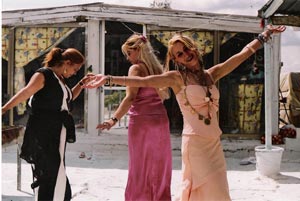 We can see the pride of the Roma of Spain, and southern France, every time we visit those lands, where Gitane/Gitano culture plays a visible and valued part in the life of the country. Flamenco is Gypsy music. They are horse-traders, songsmiths, metalworkers and lovers of freedom. This romantic image is not without problems, as we know, as it is largely one-sided. But at least it offers some status. It will take leaps of faith from the Tsiganoi of Greece, as well as hands of friendship from outside, to achieve a semblance of pride in Gypsy-dom within Greece. For now they are ‘other’, outcasts and branded as thieves and beggars, among other epithets. Theirs is a closed world, without a written history, without a homeland. They have never claimed a homeland. The truth is that everywhere the Gypsies have travelled from their caste-based beginnings in India (see the accompanying article from Ross Daly), they have assimilated. They have adapted. We have not, very much, and until we learn something about them, we will always be ‘gadje’, non-Roma, outsiders to them. They have a right to live their lives, lives that are earthy and rich in a set of traditions that will attract and repel in roughly equal measure, but it is their own. And it changes, over time, just like ours.
“Roma have to face continuing political and cultural persecution, but they still travel the ‘endless road’, making music, telling tales, tricking the gadje, raising their children, and struggling to get by. These days as well as the traditional horse-drawn wagon, they can be seen traveling by car, truck and camper van. Their communities are both urban and rural, but they are united by the common dream of the ‘endless road’, the Gypsy ideal of freedom. Gypsy music and dance continues to enrich communities everywhere they sojourn and each land they pass through. Tales of their wanderings, songs from heart, passionate music drawn from much suffering, transformed into joy by their natural exuberance. This is the folklore of the Roma, this is their generous gift to the gadje, and this must not be allowed to die.”
(c) T. Herbert 2001
The Crete Gazette will follow this feature next month, with an exclusive report from the Gypsy settlement at Alikarnassos, and a review of current developments within Crete.
Readers interested in finding out more about the Gypsies of Crete can look at the following links:
– Gypsies, their history and their music
– Roma in Wikipedia
– Unesco website: Roma in Greece
I hope we can have a 29th year reunion of the Gypsies of Crete exhibition.
if you ever run into Nikki or Larry please tell them I am coming back to Crete in 2023 and would love to see them again!
In 1978-1981, While stationed with the Air Force in Heraklion, I made friends with a GYPSY Family who lived near me on Harbor Road in the village of Chersonissos. The husband Larry sold flokati rugs to UASF personnel on base and his wife Nikki took care of their home and children. The children consisted of eldest daughter Maria, a son whose name I can’t recall, the youngest sister Katerina and youngest son called Arape (because he was very dark). I loved this family; they were always very kind and accepting of me they were very careful to never ask me to bring them anything from the base so nobody could say they were using me. I especially loved their well-behaved and cheerful children and often brought them candy and cookies from the base. I was a shift worker and the children always looked out for me to be sure that I ate something their Mother cooked before I went to work. They also served as my personal alarm clock, so I was never late for work on day shift. The Children loved Sesame Street and so when I went to work when this program was on, I would scoot the TV over to the window so they could watch the show through the open, screened window. I dearly loved them I learned fluent Greek in no time (few spoke English in 1978) and my decent Greek neighbors often pitched a fit that I had befriended this riff-raff Gypsy family, I found their opinions shocking and told them so I told them my parents did not raise me to be unkind to anyone based upon their nationality or position in life but they just shook their heads and thought I was crazy. I had three room mates in our home, two guys from work and another woman. All of us worked on base and three of us had the same shift. At first my Greek neighbors made up ugly stories about us and thought we women were American poutanas and it took two years for the entire village to realize that there was nothing indecent going on between any of us we were just American kids who worked together and shared expenses so we could live off base. I had a 1962 VW camper van and used to loan it to anyone in the village who needed it to haul anything from appliances and furniture to goats and sheep. Over the years we became beloved members of the community because we were always honest and willing to help anyone.
I would be at a restaurant on a day off, and the owner would rush up and say: Roza, that crazy Paneyotis took off with some tourist and I have nobody to wait tables!! so I would always say “mi fovasi Georgo, ego that sas voithiso!” Many times my room-mate Jimmy used his car to take a sick child and his parents to the Dr’s or hospital during an emergency. The villagers still didn’t approve of how we lived but they no longer thought we were immoral. They would shake their heads and say Treli omos kali! I thought that was a terrific complement! WHEN OUR MOTHERS CAME OVER TO VISIT US THE ENTIRE VILLAGE TREATED THEM LIKE ROYALTY! FROM THEIR RESTAURANTS THEY WOULD YELL: ROSA’S MAMMA OR DIMTRACHI’S MAMA, ELLA! AND SERVE THEM FREE COFFEE AND FOOD REFUSING ANY PAYMENT. My little gypsy care takers were tied at the hip with my Mother and escorted her everywhere. Nikki and Larry both loved my Mother and presented her with a white flokati rug from Larry’s shop!!! Her husband Larry hated Americans, but he liked us. I was really shocked that he gave my mom that 4X 5 rug!!!
In 1980 I developed early ovarian cancer and had to be flown to the USAF hospital in Wiesbaden, Germany to have chemo and a hysterectomy. This really upset my entire village as it meant I would be unable to have children and they all wondered who would want to marry Rosa now?? I was in Wiesbaden for 2 months recovering. When I came home, the entire village turned out and carried me to the plaka on a chaise lounge so everyone could come to bring me flowers, tears and well wishes. PAPA GEORGIO THE VILLAGE PRIEST RUSHED UP TO ME AND SAID, ROSA!! THANK GOD YOU ARE HOME!! THESE CRAZY VILLAGERS BURNED UP ALL THE CANDLES IN THE CHURCH PRAYING FOR YOU, AND I HAD TO DRIVE TO HERAKLION THREE TIMES TO BUY MORE CANDLES!!! IT WAS THE BEST HOMECOMING I HAVE EVER HAD AND I HAVE NEVER FELT MORE LOVED!
In 1981 the Air Force drug me screaming and kicking to Berlin West Germany for 3 years I nearly died of a broken heart, I cried every day for two months. Several Greek families were willing to adopt me and buy my way out of the military. They could not believe that I could be taken from them or that I belonged to the Air Force, that my life was not my own. I finally made it back to Crete in 1985 and they were thrilled to know I had married someone in the USAF, I went back in1998 after my husband and I divorced. I re-married in Sep 2001. They refused to allow me to retire because of 9-11 and in 2002 I was sent to Afghanistan where I caught Rheumatic fever which damaged my heart so I WAS ALLOWED TO COME BACK TO FT MEADE, MD. I RETIRED IN DEC 2003 AFTER 26 YEARS IN THE USAF AND IN JAN 2004 I HAD OPEN HEART SURGERY TO INSTALL A METAL MITRAL VALVE REPLACEMENT AND THE HEART LUNG MACHINE THREW TWO BLOOD CLOTS TO THE BACK OF MY BRAIN AND I HAD A STROKE…then I died on the operating table for 45 minutes! It took 2 years to relearn how to walk, talk and eat!!
I returned To Crete again in 2006, 2010 and 2013. Nearly all the old villagers are dead I lost track of Nikki and Larry. My Mother died in 2010 At 90.
In my entire life I have never been treated better or felt more loved than the years I was in Crete. I WLL NEVER FORGET MY GREEK FRIENDS OR MY WONDEFUL GYPSY FRIENDS, NIKKI, LARRY AND THEIR CHILDREN. DEIDRE FALXA (SINGER) GARDOCKI AKA ROZA
Thank you for this, Dierdre. Louis.