MEET MISS STEPHANIA…AND HER SEA-TURTLE FRIENDS
By John McLaren
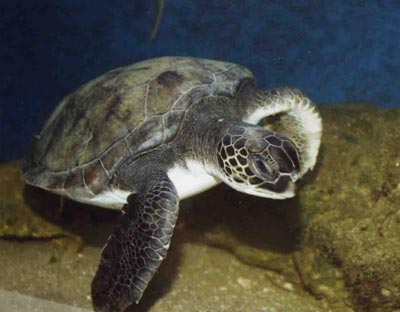
The year 2000 was not a good one for Stephania, a very pretty lady as far as Green turtles go. For some unknown reason, perhaps a fierce storm, she became stranded and helpless on the beach of a small Greek island. She lay there, too weak and tired to reach the sea, for some weeks. In the end, she became so dehydrated and starved that some young children took her for dead when they came across her. Curious, they prodded and poked at her, with one child finally sticking a needle in her eyes. This brought a feeble reaction from the dying turtle and, in spite of what they’d done, the children told their parents about their strange find.
Phone calls were made and Stephania was taken into care by volunteers of the Sea Turtle Protection Society of Greece (STPS). She was sent to their rescue centre on the outskirts of the capital, Athens. There she was slowly nursed back to health and by the middle of that summer was as healthy as ever – apart from her eyesight. Tests showed that she was completely blind and it was obvious that she could not fend for herself if released.
Having assisted the STPS several times in the past, I was asked to provide a permanent home for Stephania at Aquaworld. She has her own aquarium here and is hand-fed and cared for on a daily basis. Although she can never again enjoy a normal life in the wild, Stephania now serves as an ambassador of good will for her kind, winning the hearts and minds of all who meet her.
Green turtles (Chelonia mydas) roam many of the warmer seas of our planet. They, unlike most sea turtles, are vegetarian – enjoying a diet consisting mainly of sea algae. Their love of veggies is not, however, the reason for their name. Sea turtles were once a culinary delicacy in many parts of the world and it was known that this particular species had greenish-coloured internal fat, so they were named “green turtles” for this distinctive attribute.
Long-lived creatures, Green turtles get to be 100 years old or more. Large adults can have a carapace (the technical name for their shell) of up to 150 centimetres and they can weigh in at a hefty 400 kilos! Although quite rare in Greek waters, they do turn up from time to time on their way to and from nesting sites in Turkey and on Cyprus.
The females make a strenuous journey along selected beaches and lay nests containing anything from 50 to 240 eggs. Seven to nine weeks later the hatchlings emerge and head immediately for the sea. If they are very fortunate, they will survive the predations of the many creatures which find a small turtle to be a tasty snack and, as adults 20 years later, will return to the beach where they hatched to continue the cycle and produce their own young.
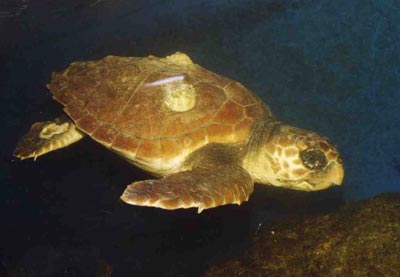
Among the other turtles in local waters are Loggerhead turtles (Caretta caretta), which are the most common of all sea turtles in the Mediterranean, nesting in several parts of Greece. Generally smaller than Green turtles, their average carapace length is about one metre and they normally tip the scales at about 100 to 150 kilos – although odd individuals have been known reach a staggering 450 kilos! Their powerful crushing jaws can cope with crabs, urchins and other molluscs which form the main part of their diet.
The leathery, or leatherback, turtle (Dermochelys coriacea) is the giant of modern sea turtles. Very rare – but nonetheless a regular – in the Mediterranean, this two-metre long creature is the most widely dispersed reptile on earth. Individuals also hold long-distance records – travelling up to 6,000 kilometres from their breeding grounds at times. They are mainly carnivorous, feeding on jelly-fish and other soft-bodied prey and it is their leather-like carapace that gives them their name.
Although sea turtles are still a staple part of the human diet in some parts of the world, and many are accidentally trapped and drowned in fishing nets each year, the main threat to turtles remains the degradation of their nesting sites. The development of beaches for tourism with the associated beach beds, umbrellas, speed boats and lights at night have destroyed many areas as breeding grounds for turtles. As a result, most turtle species are considered endangered and are included in the “Red Book” of species most at risk. Trading in turtles and their products is strictly controlled by legislation such as the Convention for International Trade in Endangered Species (CITES).
More locally, the Bern and Barcelona Conventions have been enacted to help protect turtles and their environment. Organisations such as the STPS, mentioned above, also help to guard nesting beaches and educate both local people and tourists as to their respective roles in sea turtle conservation. Small, private initiatives such as Aquaworld Aquarium also play a part in encouraging a more caring and careful attitude to these wonderful creatures.
Photos by Nathalie Deum