By John McLaren
Snake! . . . a word that causes a thrill of fear to run through the heart of many a person.
Long thought of as slimy creatures of the dark intent on poisoning us with their painful venom, snakes have been the evil-doers of many a tale since that of Adam and Eve at the beginning of creation. This primal fear many of us have of these reptiles is perhaps second only to arachnophobia – the fear of spiders – but is it well-deserved? Not in our own backyard!
In fact, the only area of the world with more venomous snakes than non-venomous is Australia, and here in Crete the balance is completely the opposite. All four species recognized as existing here are completely safe as far as we are concerned – and two of these may be said to be directly beneficial since they help keep the numbers of mice and rats around us under control.
Even so, because of the revulsion and ignorance many have for these creatures, many are needlessly slaughtered each year. That’s why I have chosen to write of them this month – to help with recognising them and seeing the snakes of Crete for what they really are – harmless parts of our living ecosystem.
THE LEOPARD SNAKE – ELAPHE SITULA
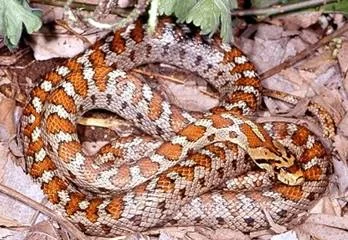
Said by snake lovers to be the most beautiful of all European snakes, the leopard snake is common throughout many low-lying parts of Crete. Rather unfortunately, this handsome reptile does sport a V-shaped marking behind its head, leading to confusion in the minds of many with the deadly adder of northern Europe. Add to this the fact that its local Greek name is Ochendra – similar to the general name given to vipers, Ochia – and you can see why this poor snake gets such a hard deal from humans here! In the north of Greece, however, the people are perhaps more at ease with the leopard snake, considering it a sign of luck to have one around and calling it Spitofido – or house snake.
Like all Cretan snakes, the leopard snake rarely gets much above one metre in length and is generally found in sunny areas with some cover, such as a dry-stone wall. Houses also provide the kind of shelter they require, obviously lending to their northern Greek name. They do not, however, object to a swim and I have found them several times in the pools of Aposolemi between Analipsis and Gouves. Should you come across one, it may well rattle its tail in an attempt to scare you off and it is capable of striking and delivering a nip to the fingers of those who try to pick it up. Although the leopard snake does eat birds and small lizards, its diet consists mainly of rodents and their young – a natural control which is important and far preferable, to my mind, to laying out poison!
THE BALKAN WHIP SNAKE – COLUBER GEMONENSIS
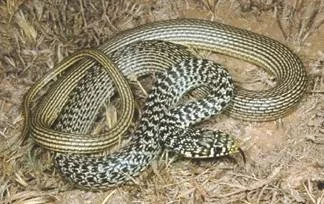
Dendrogallia in Greek, this whip snake is another which does us a favour by preying largely on rodents – although it will also take birds, lizards and large insects. Again, it prefers dry areas but can turn up near marshes and pools. The whip snake is capable of biting fiercely if threatened, but in my experience they are normally quite docile creatures and, of course, the bite itself is non-venomous.
THE DICE SNAKE – NATRIX TESSELLATE
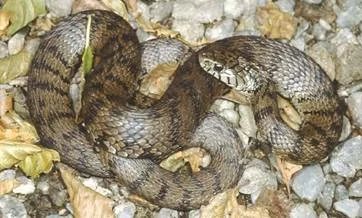
This snake is a close relative of the UK grass snake, and equally harmless. Its Greek name, Nerofido, or water snake, gives a strong indication of its habits. I have come across many of these snakes along the shores and rock pools of Sissi and Stalida. Although they are not a sea snake as such, the dice snake will spend long periods swimming and can remain submerged for considerable periods. As might be guessed, it enjoys a diet comprising almost entirely of fish. If picked up, this snake will rarely bite, but it can and does emit a strong-smelling fluid in an attempt to put its tormentor off.
THE CAT SNAKE – TELESCOPUS FALLAX
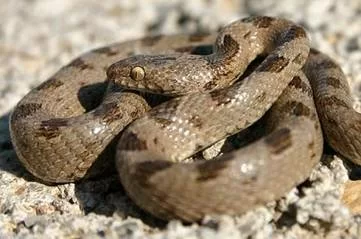
I’ve left this snake until last for a couple of reasons. Firstly, it is the only nocturnal snake on Crete and is therefore very difficult to come across. Secondly, it is the only local snake with any venom at all – but don’t be alarmed! The cat snake is considered harmless to people because it is rear-fanged and doesn’t possess the wherewithal to deliver the venom to humans. It can and does, however, use the grooved fangs at the back of its upper jaw to inject venom sufficient to kill its principal prey – geckos and small lizards. As an interesting side note, the cat snake is used in religious ceremonies in Cephalonia, so it can’t be thought of as dangerous there!
So, I hope I’ve quelled any misgivings you may have had about Cretan snakes and I urge you to treat them for what they are – an integral part of our island’s natural balance. At Aquaworld, all four species can be seen and handled, so if you are still in doubt about them or how to tell them apart – you are welcome to visit and find out more.
Photos courtesy of Amphibians and Reptiles of Europe
Hey does anyone know anything about a 1 meter long,all black snake living here in Crete? I have one living I’m my pool house, in Kokkino Chorio, and idon’t know if it is dangerous, poisonous or any risk to me or my dog?? how do I get it to move out of my pool room??? any comments very much appreciated
Probably it is a dice snake and it is not poisonous.
Moving to Crete,with our two Cats.
Do we have to be concerned about
Snakes biting our Cats
We came across two green striped snakes mating (?) entwined while hiking in Imbros gorge on Crete. They were long and big. Can’t find them identified anywhere on web. There is no water in the gorge. They were definitely green AND striped. June 2021.
thank you for this amazing article im going to Crete in 6 months so i was doing some research im looking forward to seeing THE BALKAN WHIP SNAKE.
As mentioned above a snake’s biggest predator is the domestic cat which because of its uncontrollable nature preys on anything it can. In fact, in the UK , over 4.000,000 wildlife creatures are killed by domestic cats every year.
We had black snakes on our property in Ayios Onouphrios in Western Crete—what were they? The adult was very long —about two feet
This is exactly the reason I entered “snakes of Crete” in Google and landed on this website. My uncle claims that he saw a very large black snake in Kastamonitsa near Kasteli. What was it?
Michael,
A friend of mine from Crete just posted a video on Facebook of a black& white very small snake. If you have a facebook messenger, I could forward the video to you. I wish we know what it is
Thank you for a very interesting article.
Today I saw what looks like a balkan whip snake on a stone wall in front of my house. It was about 40/50 cm long, very thin, and looked really beautiful! I hope it stays and that my cats will leave it alone.
A most interesting incite into the variety of snakes living here in Crete. Most enlightening and educational so thank you!
We live in Kokkino Chorio in eastern Crete and today saw a beautiful Balkan Whip Snake. Once it had seen us it bolted through a small hole into our boundary wall. We are glad to have such a beautiful creature living on our property and look forward to seeing it again.
When we arrived at creet, we had to get on a coach to get to our hotel. I was sat next to the window just looking out of it, waiting to arrive. Then, all of a sudden, someone shouted “Lepord snake! Its a lepord snake!”. Some screamed some laughed but luckily I was on the right side so I stared out of the window,waiting for my turn to look at it. It was about 30cm long and it looked amazing!
We saw a little Dice snake in the palm
Forest at Preveli in the rock pools. Very peaceful and pretty !
While tending a neighbours garden in Nofalias, Eastern Crete I was intrigued to discover what I now know to be a Balkan Whip snake in the bottom of a 5 metre deep concrete water tank. The tank was virtually dry and having sheer sides suggested that the snake must have fallen in! It was about a metre long and presumably an adult. My wife and I contrived an impromtu “ladder” from a tree trunk and a daily inspection led us to believe the creature made its escape and is hopefully now back at work on the local rat population.
I saw a Leopard Snake near my garden in the cultivated area at the side of a village last week. It was around 30-35cm long and is the first snake I have seen here in Crete. A beautiful animal. I also saw a lage Balkan Lizard on the same morning. A very impressive and colourful day out considering all I had was digging a few trenches and devising a water system in mind.
Thank you, John for this article, which shed some light onto my area of interest. Aren’t they so beautifull, these four Cretan species! Id love to come to Aquaworld and have an experience of actually handling them. You made me very curious about “the cat snake is used in religious ceremonies in Cephalonia”.As Im interested in the Minoan history and aware of course of the Snake goddess statue, I am wondering what kind of snakes she was using and also what exactly are these ceremonies in Cephalonia? I know you probably wont reply to this post but it’ll serve as my reminder to research this more. Anyway, thanks for the article – I wish that people were educated more and stopped this needless destroying of these usefull and awasome creatures.