Stellamara in Concert becomes Labyrinth’s Shining Star
By Steve Galloway
 Another joyful celebration of music at the Labyrinth brought a fitting end to a season of musical excursions, leaving us waiting until next year for new surprises from Ross Daly and his friends and collaborators.
The season of shows, several of which we have reviewed in The Crete Gazette, was organised by Mr. Daly, an English/Irish born resident of Crete, and they took place in Houdetsi, a village in the district of Heraklion, not far from Archanes. In the heart of the village stands a big stone villa, facing a lawn bordered by trees and plants. It is here that the Labyrinth Musical Workshop operates, and with contacts around the world, is able to compile an exceptionally varied and interesting programme each summer. You may wish to see the fine collection of musical instruments housed within, and can contact the centre through the website https://www.labyrinthmusic.gr/
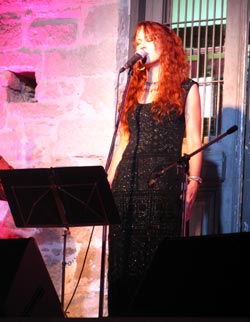
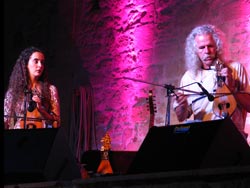
This last show was not featured in the season’s published programme; it was added late in the day and did not receive as much publicity as it perhaps deserved. We saw a North American-based group called StellaMara, featuring the talents of some six musicians, joined here by Mr. Daly and Kelli Thoma playing lyras. StellaMara means ‘star of the sea.’ However, and on this night one star could not help but shine brighter than most. The singer is called Sonja Drakulich, and she does indeed shine.
Sonja was accompanied by musicians who are able to be innovative while still retaining the disciplines of traditional song-making; folk traditions that never lose their direct appeal to the heart and body. That we live in a complicated world today, made smaller by technology and movement of peoples, is reflected by StellaMara’s approach to the material, their own compositions and arrangements of older melodies, primarily from the countries of their families’ roots; Serbia, Croatia and Hungary. The cello, an instrument I have rarely heard in folk music, was to the front, along with various drums and wind instruments. To try to summarise the concert would be to do the musicians a disservice. I am a newcomer to these sounds, in many ways, and can only say that they made me feel very good indeed. First, you are lifted by the combination of voice and music. Then left feeling a lost sadness that those without countries must feel. Then, again, picked up by the confidence, vitality and powerful humanity of such emphatic playing, the endless optimism of the human spirit that comes out of knowing that at least one thing will survive. The music has been passed down through the generations and in these hands, is safe. Not empty repetition, but a desire to reach new hearts and souls has taken it, via the USA, to Crete, and we are all invited to the celebration.
Sonja was really something quite special to see and hear. She doesn’t do anything unnecessary with her voice, yet displays a range of textures and finesse that left me and my two friends, not exactly impressionable youths, looking at each other with raised eyebrows and that pursed-lipped expression seen sometimes in Greece – “was that good or what?” This woman can fly, in song. That she also looks quite beautiful is somehow an irrelevance, but should also be said.
We were, in no particular order, Yannis Samatas of explorecrete.com and Lou Duro, hard-bitten journalist and editor of The Crete Gazette, along with myself. It seemed a worthwhile effort to ask Sonja, after the show, some questions about her group, the connection with Ross Daly and Crete. We were met by a woman for whom the music is the key, an extension of her interest in the mythological, in the significance of the past in the present and in breaking down the barriers between cultures that cause so much damage in our world. She had been singing five minutes before, but could not have been more charming or more helpful in answering our questions.
 We talked about ‘modal’ music, heard in Byzantine and Eastern European music since antiquity, being based upon melody and sounds, so much more accessible than the scales taught in classical, post-renaissance Europe. This Eastern approach is like “colours blown up”. The sounds of the East being a vibration shared among most of the world. She would like to work with North American traditions, and has been playing Appalachian mountain music for some time.
We can only wonder where she will go next, because this talented woman has a voice that compels you to listen. The group have known Ross Daly for some time, and have been inspired by his particular quest. It may well be that they will return to Crete, perhaps next summer. If you get the chance, catch up with StellaMara.
Read more about StellaMara at www.stellamara.com